5 min read
Why MEP Subcontractors Feel the Cash Flow Squeeze Before Anyone Else
Alexis Vail
:
Jun 16, 2026 1:52:12 PM
MEP subcontractors sit at one of the most demanding points in the construction payment cycle.
Electrical, mechanical, plumbing, HVAC, fire protection, controls, and low-voltage contractors are not simply “installing work.” They are coordinating with multiple trades, managing long-lead materials, staffing specialized crews, reacting to schedule shifts, supporting inspections, handling change work, and keeping projects moving through some of the most technically complex phases of construction.
But the financial side of the job often moves much slower than the field work.
A subcontractor may have crews on site this week, materials purchased last month, an approved invoice submitted today, and payment arriving weeks later. That timing mismatch is where the pressure builds.
For many MEP contractors, the problem is not that the business is unhealthy. It is that the business is being asked to finance too much of the project timeline at once.
Industry research continues to show that delayed payment is a persistent issue in construction. A 2025 Construction Dive summary reported that 43% of subcontractors said they did not have enough working capital to cover unexpected expenses or project delays. Separately, PYMNTS reported that delayed payments create immediate cash flow constraints for 44% of subcontractors.
For MEP subcontractors, that pressure can show up earlier — and harder — because of how their work is structured.
MEP work starts before the pay cycle catches up
MEP subcontractors often have to commit cash before revenue from the job is actually collected.
Before an invoice is paid, the subcontractor may already be covering:
- Payroll for licensed labor and field crews
- Material purchases for pipe, wire, fixtures, equipment, panels, duct, controls, or specialty components
- Equipment rentals and mobilization costs
- Supplier deposits or early procurement needs
- Project management and coordination time
- Insurance, bonding, compliance, and administrative overhead
- Change order work that may take time to document, approve, and bill
The invoice may eventually be approved. The receivable may be valid. The project may be profitable on paper.
But the business still has to survive the timing gap between doing the work and collecting the cash.
That is the part many financial products fail to understand. MEP subcontractors do not always need a loan because the business is broken. Often, they need better timing because the payment cycle is slow.
The cash flow pressure is not just about slow payment
It is easy to reduce construction cash flow problems to one phrase: “slow pay.”
But for MEP subcontractors, the real issue is more layered.
Payment timing is only one part of the problem. The larger problem is that cash is moving out of the business in several directions at once.
A mechanical contractor may need to purchase equipment before a project milestone is billed. An electrical contractor may have to keep crews moving while waiting for payment on previously approved work. A plumbing contractor may be pulled into change work that creates additional labor and material costs before the paperwork catches up. A fire protection contractor may have multiple jobs in different billing stages, each with different approval timelines.
On paper, the contractor may have a strong backlog and a healthy pipeline.
In the bank account, the picture may feel very different.
That disconnect matters because construction businesses do not fail only when they run out of work. They also get constrained when too much cash is trapped in receivables.
Labor, materials, and timing all collide
MEP contractors are especially exposed because their cost structure is both labor-intensive and material-sensitive.
Labor has to be paid on a predictable schedule. Suppliers expect payment based on their terms. Projects, however, rarely pay on the same rhythm.
That creates a familiar squeeze:
-
The subcontractor pays weekly or biweekly payroll.
-
The supplier invoice may be due in 30 days.
-
The pay application may take time to approve.
-
The actual payment may come weeks after approval.
-
Meanwhile, the next job is already starting.
This is where cash flow becomes more than a finance issue. It becomes an operations issue.
When cash is tight, subcontractors may have to delay material orders, slow hiring, hold off on taking new work, lean harder on credit cards, or stretch supplier relationships. None of those moves necessarily show up in a job cost report right away, but they can affect project execution and growth.
Recent industry coverage has also pointed to persistent pressure from labor shortages, material volatility, and regional market conditions. Gordian’s 2025 construction cost analysis noted that labor shortages, material volatility, and regional market pressures continued to drive cost concerns, even as the rate of cost growth moderated.
For MEP subcontractors, that means the margin for error is thin. If payment timing slips, a profitable job can still create a cash crunch.
Approved receivables can still create a working capital gap
One of the most frustrating parts of construction finance is that an approved invoice does not always feel like cash.
Once work is completed, billed, and approved, the subcontractor has created value. But until payment arrives, that value is locked inside accounts receivable.
That creates a working capital gap.
For example, imagine an electrical subcontractor has a $250,000 approved invoice on a commercial project. The work is complete. The invoice is approved. Payment is expected, but not for several weeks.
During that waiting period, the contractor still needs to:
- Run payroll
- Buy materials for the next phase
- Support another active job
- Cover overhead
- Preserve supplier relationships
- Prepare for upcoming mobilization costs
The receivable is real, but it is not yet usable.
That is the gap approved-invoice acceleration is designed to address.
How MEP subcontractors can think about cash flow more strategically
A stronger cash flow strategy starts by separating three different problems that often get lumped together.
The first is profitability. Is the job priced correctly? Are labor and materials being managed well? Are change orders documented and captured?
The second is payment certainty. Has the work been approved? Is the invoice clean? Are there disputes, missing documentation, or compliance issues?
The third is payment timing. Even if the invoice is valid and approved, how long will it take for cash to arrive?
MEP contractors need to manage all three, but they are not the same problem.
A loan may help with general working capital, but it adds debt and may not be tied to specific project receivables. A merchant cash advance may provide speed, but it can create a repayment burden that does not match construction payment cycles. Factoring may help some businesses, but it can vary widely in structure, cost, customer experience, and fit.
Approved-invoice acceleration is different because it is tied to receivables the subcontractor has already earned and had approved.
That distinction matters.
It means the financing conversation is not just “How do we borrow more money?” It becomes “How do we unlock cash from work we have already completed?”
Where Early Pay fits — and where it does not
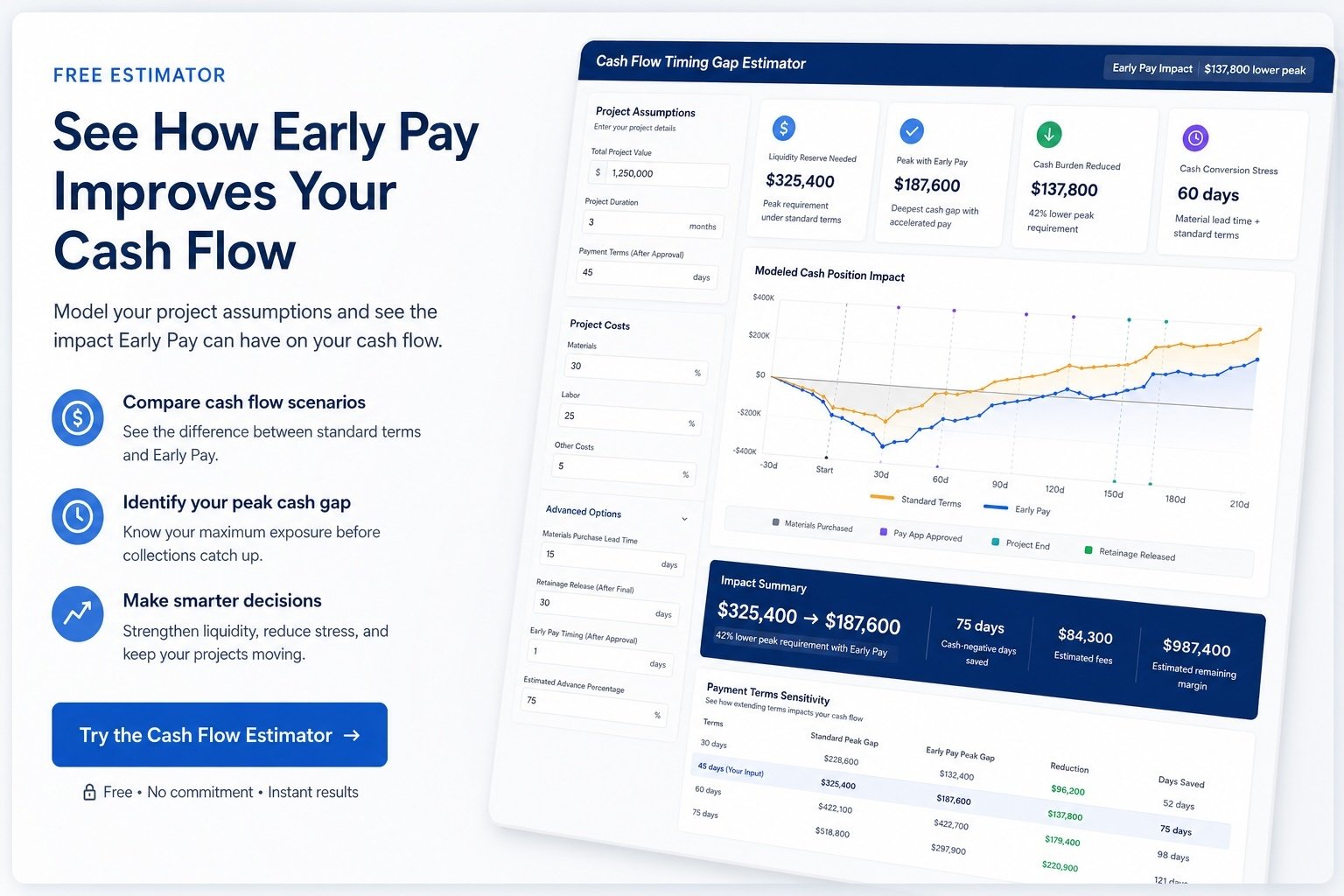
Constrafor’s Early Pay Program is built for subcontractors that have approved invoices and want to accelerate payment instead of waiting through the normal payment cycle.
For MEP subcontractors, that can be useful when cash is needed to support:
- Payroll
- Materials
- Equipment
- Project startup costs
- Supplier payments
- Mobilization on the next job
- General working capital timing gaps
The key phrase is approved invoices.
Early Pay is not a solution for every cash flow challenge. It is not designed to solve retainage. It is not for unapproved invoices. It does not fix underpriced work, project losses, disputed change orders, or poor job costing.
But when a subcontractor has approved receivables and the main issue is timing, accelerating payment can be a practical way to improve cash flow without taking on traditional debt.
That can be especially valuable for MEP contractors because their work often requires cash before the next payment arrives.
The real issue: MEP subs are financing the project schedule
Construction likes to talk about schedules in terms of labor, materials, inspections, and milestones.
But every schedule has a financial shadow.
When a project schedule shifts, cash flow shifts with it. When approvals take longer, cash gets trapped longer. When materials need to be purchased early, the subcontractor absorbs that timing burden. When crews have to stay active across multiple jobs, payroll does not wait for the payment chain to clear.
MEP subcontractors are often expected to keep the job moving while carrying that financial load.
That is why cash flow should not be treated as a back-office issue. It is central to project execution.
A subcontractor with stronger cash timing can make better decisions. They can buy materials when needed, support crews without scrambling, pursue the next project with more confidence, and avoid using expensive emergency capital just because an approved invoice has not been paid yet.
Final takeaway
MEP subcontractors do some of the most essential work on a construction project, but they often operate inside one of the toughest cash flow environments.
They are asked to coordinate complex scopes, absorb labor and material costs, manage schedule changes, and keep projects moving — all while waiting for payment on work that may already be approved.
That is why approved receivables should be viewed as more than accounting entries. They are potential working capital.
For subcontractors with approved invoices, Constrafor’s Early Pay Program can help convert those receivables into faster cash flow, giving MEP contractors more control over timing without relying on traditional debt.